1. Introduction: The Death of the Compact Compromise
For the better part of a decade, choosing a compact flagship (Vivo X300 FE) was an exercise in managed disappointment. To get a device that didn’t strain the pocket, users were forced into a “compact compromise”: anemic batteries, throttled silicon, and camera systems that felt like afterthoughts compared to their “Ultra” siblings. But the 2026 market landscape has shifted. The Vivo X300 FE arrives not as a “Lite” alternative, but as a strategic category killer. It is the successor that has effectively replaced the base X300, proving that ergonomics no longer require an apology. This isn’t just a small phone; it is a high-density powerhouse that challenges the very necessity of the oversized flagship.
2. The Battery Paradox of Vivo X300 FE: 6500mAh in a 7.99mm Body
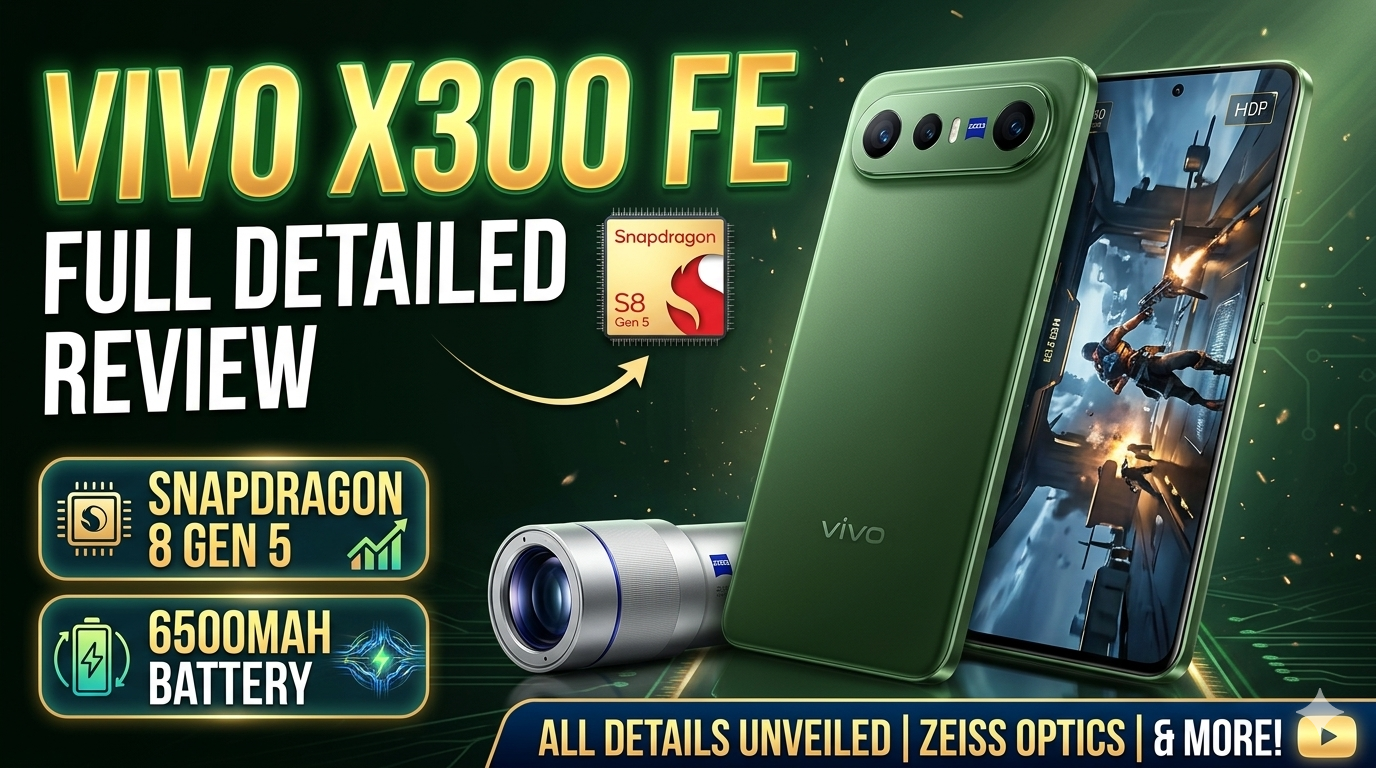
The headline achievement of the Vivo X300 FE is a genuine defiance of smartphone physics. Within a slender 7.99mm chassis and a 6.31-inch frame, Vivo X300 FE has squeezed a massive 6500mAh battery. This is made possible by silicon-carbon battery technology, offering an energy density that leaves the iPhone 17 and Galaxy S-series compacts looking antiquated. While competitors struggle to hit the 5000mAh mark, the X300 FE provides multi-day endurance without the bulk. Furthermore, Vivo refuses to follow the “no charger” trend; the box includes a 90W Flash Charge adapter, capable of reviving this beast in minutes, alongside 40W wireless and reverse wireless capabilities.
“Vivo has produced a non-compromise compact flagship… it doesn’t just focus on being compact; it focuses on ensuring nothing feels like a compromise during use.”
3. The “Elite” Silicon Shift: Snapdragon 8 Gen 5
The “FE” moniker usually denotes a step down in silicon, but here it signals a leap forward. The X300 FE has ditched the MediaTek internals of its predecessor for the Qualcomm Snapdragon 8 Gen 5. Built on the same Oryon CPU nodes as the “Elite” tier chips, this processor features the world’s first 20-bit ISP, a detail that significantly elevates its image processing capabilities.
The performance metrics are staggering, with AnTuTu scores hitting the 2.8M to 3M range. To keep this “Elite” power from melting a compact frame, Vivo integrated a 4500mm² vapor chamber. The result? Thermal stability that was once impossible in this size class. In sustained gaming sessions of Genshin Impact, the device maintains a rock-solid 59+ FPS while staying under 41°C—a far cry from the 44°C throttle-fests of previous compact generations. With UFS 4.1 storage and LPDDR5X RAM, this is “Ultra” performance in a 191g body.
4. Pro-Grade Optics: The Zeiss Multi-Focal Portrait System
Visually, the X300 FE marks a departure from Vivo’s signature circular “X” design, opting instead for a sophisticated vertical pill-shaped camera module set against an aerospace-grade aluminum frame. This array houses a 50MP Sony IMX921 main sensor and a 50MP Sony IMX882 Telephoto lens, both tuned with Zeiss optics.
The Zeiss Multi-focal Portrait system is the star here, covering the crucial 23mm to 100mm range. The edge detection and “DSLR-level” bokeh drop-off produce images that look organic rather than over-processed. Whether it’s the natural color science of the Zeiss Master Color Display or the 4K 120fps video capability, the optics feel professional.
“The edge detection and background blur are to the point. You won’t feel that these photos are taken with a smartphone; it delivers a natural, professional look.”
5. The Modular Advantage: The Gen 2 Telephoto Extender
Compact phones are traditionally limited by the physical depth of their lenses, but Vivo’s Telephoto Extender Gen 2 provides a modular solution. This Zeiss-certified accessory, finished in a premium silver metal, attaches via a dedicated textured case. It offers a 2.35x magnification, pushing the optical-grade reach of the telephoto sensor to 200mm and beyond.
This modular system allows a pocketable daily driver to suddenly compete in wildlife or sports photography—scenarios that usually require a 230g “Ultra” phone or a dedicated DSLR. It’s an experimental yet highly practical fix for the physical constraints of small-form-factor photography.
6. All-Screen Experience: 94% Ratio and Ultrasonic Security
The display on the X300 FE is a masterclass in immersion. The 6.31-inch LTPO AMOLED panel boasts a 94.38% screen-to-body ratio, making the bezels nearly invisible. With a peak brightness of 5000 nits, the HDR performance—specifically the “natural look” of high-contrast scenes—is market-leading.
Vivo has also addressed a common compact frustration by moving from an optical scanner to a high-placed ultrasonic fingerprint sensor. It’s faster, works with wet fingers, and is ergonomically placed for easy reach. Coupled with an IP68/IP69 dual rating, the X300 FE is protected against both submersion and high-pressure steam, a level of durability rarely seen even in the highest price brackets.
7. Conclusion: A New Blueprint for the Flagship “Lite.”
Starting at approximately ₹79,999, the Vivo X300 FE isn’t trying to be the “affordable” alternative; it’s trying to be the smarter choice. By packing a 6500mAh battery and Snapdragon 8 Gen 5 silicon into a refined, 191g aerospace-aluminum body, Vivo has effectively deleted the need for “Ultra” bulk for 95% of users.
The X300 FE is a disruptor that proves the “Fan Edition” has grown up. It poses a fundamental question for the 2026 consumer: If you can have the battery, the power, and the professional optics in a phone that fits in one hand, why are we still carrying bricks? The “Ultra” shadow has finally been outgrown. For more phone and gadgets-related updates, always visit our site: Sathik Jankari.